The Blue Book Backlash: Why "Going Analog" is a Failure of Imagination
February 3, 2026
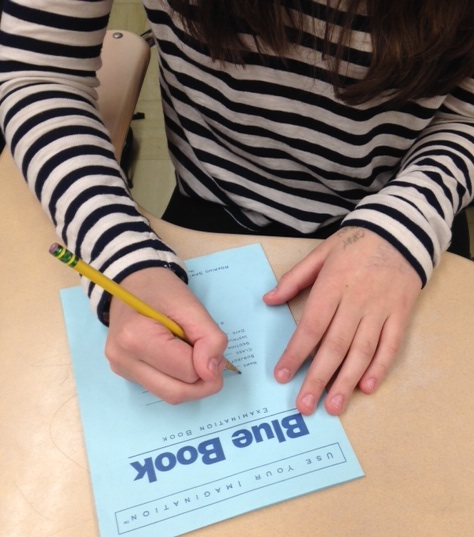
If you want to see the panic in higher education right now, you don’t need to read the faculty meeting minutes. You just need to look at the bookstore receipts.
According to recent reporting from the Wall Street Journal and The Observer, sales of "blue book" exam booklets have skyrocketed in the 2024–2025 academic year. At the University of Florida, sales are up 50%. At some University of California schools they have surged by 80%.
If we plotted this on a graph, it wouldn't look like a trend line; it would look like a cliff.
Facing a deluge of AI-generated papers, universities are pulling the emergency brake. They are banning laptops, disabling Wi-Fi, and forcing students back to the 19th-century method of handwritten exams. It feels like a decisive solution: If we remove the screen, we remove the bot.
But while this "Blue Book Spike" might solve the immediate problem of cheating, it is creating a far more dangerous one: The Equity Gap.
Handwriting is a Tax on Thinking
For a neurotypical student, a handwritten exam is an annoyance—a hand cramp and a smudge of ink. But for the 21% of undergraduates who report having a disability (GAO, 2024), it is a discriminatory barrier.
Students with dysgraphia, dyslexia, or motor processing issues rely on digital tools not to "cheat," but to translate their thoughts into text. When we strip away spellcheck, grammar aids, and keyboards, we aren't leveling the playing field. We are digging a trench.
The "Equity Gap" Visualizer below demonstrates exactly what happens when you hit "Blue Book Mode."
What the Data Shows: As you can see in the visualization, removing digital tools creates a "double penalty" for specific student profiles:
- The Speed Penalty: The average adult types 40 words per minute (wpm) but handwrites only 13–15 wpm. In a timed blue book exam, a student who thinks just as fast but writes slower is mathematically capped at a lower grade. They physically cannot output the same volume of ideas.
- The ESL Hurdle: For the 1.2 million international students in the U.S., digital translation and grammar tools are essential scaffolding. Removing them creates a "false positive" for incompetence—grading their language fluency rather than their subject mastery.
- The "Innocence" Problem: Perhaps most alarming is the rise of "AI Anxiety." Students are now terrified that their natural writing style will be flagged by a biased detector. Going analog removes that fear, but at the cost of their actual workflow.
The Workforce Disconnect
Beyond the equity issue, there is a massive disconnect between how we are testing students and how we expect them to work.
While universities are buying paper booklets by the truckload, employers are buying AI licenses. The modern workforce is not looking for employees who can write a perfect essay by hand in isolation. They are looking for digital synthesizers—people who can orchestrate AI tools to produce high-quality work faster.
By reverting to blue books, higher ed is widening the gap between the degree and the career. We are training students for a world that no longer exists.
The Solution: Verify the Process, Not Just the Product
The alternative to "going analog" isn't "unchecked AI." It is Process Visibility.
We need to stop grading the final commodity (the essay) and start validating the journey. This is where Rumi shifts the paradigm. Instead of banning the tools, Rumi acts as a "flight recorder" for the writing process. It captures the drafting, the editing, the backspacing, and the thinking.
- If a student uses AI to brainstorm? Rumi captures it.
- If a student writes the core argument themselves? Rumi verifies it.
- If a student uses a grammar tool to polish the prose? Rumi distinguishes that from "generation."
This allows universities to keep the digital tools that make education accessible, while still ensuring that the student is doing the cognitive lifting.
The answer to the AI crisis isn't to retreat to the past. It's to bring transparency to the future. Let’s put the blue books back on the shelf and start grading the process.
