Every Keystroke You Type in Google Docs and Microsoft Word is Already Being Recorded
April 27, 2026
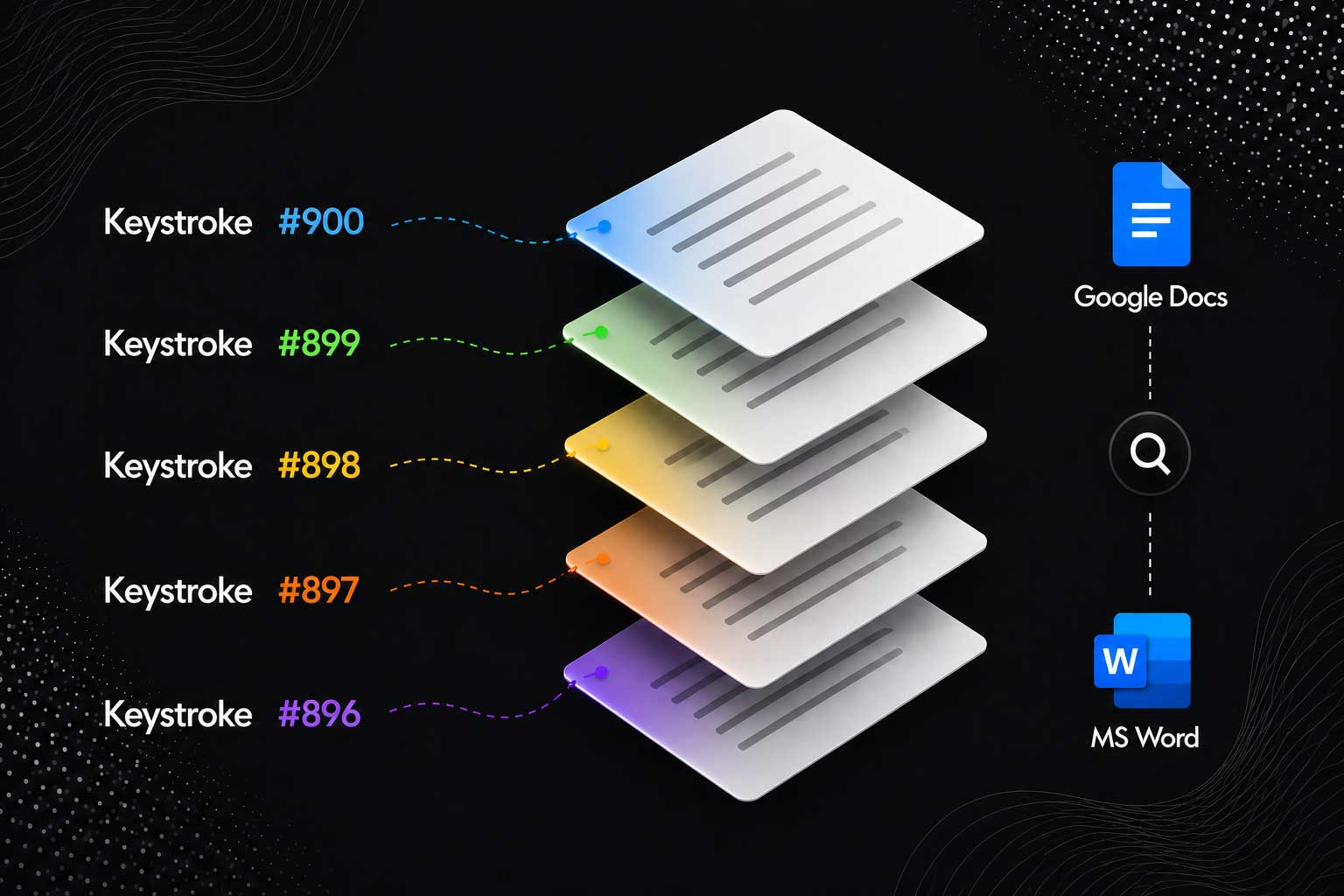
Most people don’t know this: Every Google Doc you’ve written since 2010 contains a microsecond-accurate record of every key you ever pressed. (source)
Every word you deleted, every awkward phrasing you backspaced over, and every 2 a.m. struggle with a thesis statement is preserved in a permanent, append-only ledger. Since Microsoft Word’s "Cloud-First" shift in late 2025, the same is now true for Word; documents are streamed to the cloud from the very first keystroke, often before you’ve even given the file a name.
This isn’t a leak or a conspiracy. It’s the standard infrastructure of modern writing—and it affects almost everyone on Earth.
The Word Processor Duopoly
As of 2026, Google Workspace and Microsoft 365 control more than 95% of the office productivity market. In education, Google alone is the "de facto" platform for 170 million students and teachers. If you wrote it on a computer in the last fifteen years, you weren't just using a tool; you were contributing to a ledger you didn't know existed.
We bring this up because the most common concern we hear about Rumi is that capturing the writing process feels "invasive." But that concern rests on a misunderstanding of what surveillance actually is.
Surveillance vs. Insight
When we think of surveillance, we usually imagine a camera being turned on. We notice the "new" thing. Because Rumi explicitly shows you the writing process, it feels like "new" tracking.
But real surveillance is more like background noise—always there, quietly recording, even when we don’t notice it. The important difference isn’t whether data is collected—it’s whether you can see and use it. That’s where surveillance turns into insight.
- Passive Recording (Surveillance): This is what Google and Microsoft do. It happens behind a one-way mirror. The data is collected silently, stored in a corporate vault, and used for AI training or analytics. You have no visibility into what they know about your struggle to write.
- Active Disclosure (Insight): This is what Rumi does. It’s a two-way mirror. We turn the "projector" around so the student sees exactly what the platform sees.
Surveillance isn't the act of recording; it is the act of keeping that recording a secret from the person being recorded.
Your Writing Is Already Being Recorded
As programmer James Somers demonstrated, a Google Doc is a living ledger. Every character has a persistent unique ID. If you cut a sentence from page 10 and paste it on page 1, that character’s ID—and its original timestamp—remains.
If you’ve ever used the Draftback extension to play back a Doc like a movie, you’ve seen this "shadow data" in action. Draftback didn't invent that movie; it just hit "Play" on a film Google had already recorded. With the 2025 shift to "Cloud-First" defaults, Microsoft has gone a step further, making every draft "Copilot-ready" from the first keystroke.
What This Means for Classrooms
The real surveillance problem in education today is presumed guilt. AI detectors return a percentage and a verdict: "This looks like AI." They force students to defend themselves against a black-box algorithm. That is a "spy camera" model.
Process visibility is a "mirror" model. It doesn't watch the person; it respects the evolution of the text. Genuine intellectual work leaves a trace that AI cannot retroactively manufacture: the rhythmic pauses, the dead-end paragraphs, the arguments that shift direction as the writer learns.
When that trace is visible, the student stops needing to "prove a negative" to an AI detector. Instead, they have a verified receipt of their own thinking.
The data exists either way. The only question is who it serves.
Giving Students the Projector
The writing process is the only honest artifact of how thinking happens. For decades, Google and Microsoft have been keeping the film of your work in a vault. Rumi just gives the student the projector.
You aren’t being "newly watched." You’re finally being shown what was already there—and for the first time, it belongs to you.
